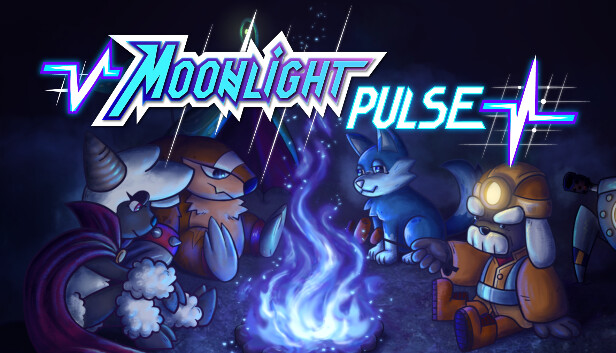
Last year, we published a pair of articles reviewing the indie game demos we played at PAX East, and I singled out a small title, Moonlight Pulse, as the demo that had me most excited. The game released on Steam this past week, and I was happy to finally play through the full thing.
Moonlight Pulse is a 2D metroidvania about a group of (not anthropomorphic) animals who live inside a giant space turtle. As the turtle is their home, many of these creatures have taken it upon themselves to defend the turtle from its recent parasite infestation. Starting the game as Silex the mole, you will explore this bizarre setting and collect various upgrades in your efforts to rout the parasites. You will also pick up three more characters, who serve as the game’s primary mechanic. With the tap of a button, you can instantly cycle through the characters in your party, who each have different fighting styles and traversal options. This is the game’s selling point, as the transition between characters is absolutely seamless, allowing you to access a different moveset instantly while maintaining momentum. This leads to platforming challenges where you are expected to swap characters in midair and chain the abilities of the four characters together, while giving you enough options that understanding how to reach a point can be a puzzle in and of itself. This simultaneously becomes both the game’s biggest strength and its biggest weakness.
Swapping characters feels wonderful, but for those of us who are used to the traditional system of hunting for powerups and new equipment in a game of the genre, it changes how we get those abilities. There are still various stat increases (specific to each character) and pieces of equipment that augment the group’s combat capabilities, but movement options are largely earned through story progression, rather than by finding the tools. This may be off putting for fans of the genre, though I am unsure it is any different from getting Samus’s grapple beam after killing a boss. At various points, the characters will stop to chat, and they will learn of new moves they can do through these conversations with each other. It occasionally presents a question of why these abilities were not previously available if a character was capable of using them the whole time, particularly in the case of Charlotte’s gliding, but if you can stomach a small bit of fridge logic, it ensures that new parts of the game are always opening up for you. To that end, the game does feel a bit more linear than is standard for a metroidvania, using these plot-granted abilities to herd the player towards certain areas, but each one is somehow useful for reaching optional items that were most certainly passed earlier in the game, which properly encourages the player to keep exploring and doubling back to earlier areas.
To make the process of doubling back less painful, there are a series of fast travel points, which take the form of the turtle’s veins. The characters can hop into openings in them and ride the stream to other openings, functioning much like a living subway system. The veins are blocked by parasites in various locations, so the more abilities the player gains, the more of these they can reach and remove to open up more efficient travel throughout the map. While this method is slower than teleporting the player around, it makes the fast travel points feel earned, and reminds the player of areas they are passing by in case they notice something they can now interact with in an old area. I rather liked this system, and the goofy animations of the characters swimming along added a bit of personality to it.
Combat starts fairly simply, as Silex has a flip dash and a direction claw attack, plus the ability to add elemental damage to his attack with certain pickups. It’s plenty to deal with early game enemies, but as the foes grow more complex, so too do the player’s options. Laguna’s water powers give him the group’s only (low damage) projectile, as well as a ground pound and the ability to temporarily immobilize enemies in bubbles while applying elemental weaknesses to them. Charlotte wields a whip reminiscent of Castlevania, which can be swung in multiple directions and which boasts a sweetspot at the tip. Clyde offers a short range flamethrower, including the ability to hover by aiming it straight down, and the ability to generate temporary platforms for added tactical decisions. Each of these options convert into interesting ways to interact with the map, such as using bubbles to alter underwater momentum, grappling onto ledges, and positioning platforms in just the right spot to make the most of other options. The enemies remain relatively basic throughout the game (bosses aside) but offer just enough challenge through their high damage output. It’s game over if any character goes down, but if a character would be defeated, they will be left with 1 HP while a random teammate will take over, suffering the remainder of the damage. However, it can only be done so many times between save points. This creates a choice in combat; do you switch back to the low health character you need knowing you may run out on the next hit and game over, or do you adapt to fighting as a character less well suited to the situation?
While the gameplay is Moonlight Pulse’s primary draw, the writing deserves a shoutout for the effort that went into it. The plot is largely a fun little coming of age story for Laguna and Charlotte, but the somewhat cheesy camaraderie of the player characters is contrasted by a surprisingly dark antagonist. The game features multiple endings depending on how the final battle with him goes, and that battle’s circumstances are directly affected by how many of the parasites have been removed over the course of the game. The NPCs the player will encounter are suitably memorable little characters, made better by the fact that their dialogue updates after every boss, and that they always have something different to say depending on which character is speaking to them. I was worried that the party’s chattiness would interrupt the flow of the gameplay, but past the tutorial, they’re suitably spaced so as to be more of a treat when they appear than an interruption. As an added bit of fun, after you defeat a given enemy a certain number of times, the casts’ collective journal in the pause menu is updated with the group’s thoughts on that enemy, giving each and every bit of the world that extra bit of personality and charm.
The game’s sound design is… acceptable. The music is always fitting for the situation, but there aren’t any songs I expect to remember in a week. What it does right is provide satisfying sound effects for both landing hits and using various abilities. Nothing in the game’s sound department is impressive, but it all does the job well enough. The visuals are rather nice, with some lovely sprite work for characters and enemies alike. Curiously, the character portraits in conversation manage to look worse than the art just about everywhere else, which might make this the only time I’ve ever encountered such a situation. Usually the conversational portraits are the best pieces in a game. That one hangup aside, the artist deserves credit for making such clear and expressive sprites. This goes primarily for the player characters, but also for the two giant bosses whose size necessitated their being significantly more detailed than anything else in the game.
Moonlight Pulse clocked in at a relatively short 5 hours for me. I finished with 100%, and really only found myself scouring the map for one or two little things before it was time for the final boss, which speaks to how well laid out everything is that I had found most of the game’s secrets by playing normally and poking my head around. There’s definitely a few tricky hiding places throughout, but if you have any instincts for this style of game, you’ll figure them out. The game is quite charming, with lots of little details best experienced for oneself that I haven’t gone too far into, and I enjoyed my time with it. Some mechanics are a bit underused, and it is clear that this was an indie developer’s first time achieving their vision, but that vision was most certainly achieved. Some talented people worked on this, and I always appreciate a game that focuses on having movement as good as this one does. I give Moonlight Pulse a B+. If you enjoy weird, charming little worlds, or excellent 2D movement, I would absolutely recommend it.
 Nerdcrash!