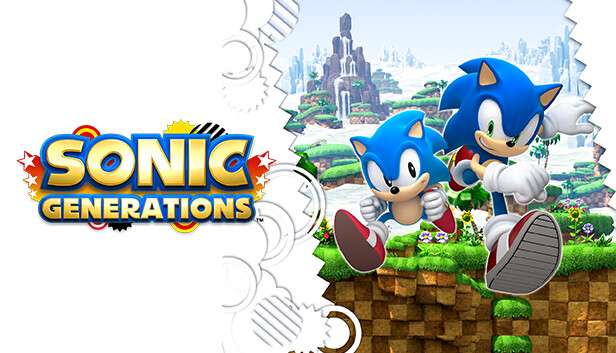
Following the more positive reception to Sonic Colors, things were looking up for the franchise; all Sega had to do was produce a worthy follow-up. With the series’ 20th anniversary approaching, they wanted to do something special, something that wouldn’t produce the disastrous results of their 15th anniversary title. So, come 2011, the fans grew excited for Sonic Generations, a game which had already surprised them in the advertising by revealing its two playable characters, Sonic and… Classic Sonic? The gimmick was obvious once we saw it, but it was welcomed nonetheless. Generations featured a level taken from each of what Sega had deemed to be the games in the mainline series, and each level was split into two: One half would use Sonic’s 3D gameplay as lifted from Colors, and the other half would be a 2D level harkening back to the classic Genesis titles, with Classic Sonic as the player character. It was to be a celebration of everything that had come before, remastering old content for the modern game style, and remastering newer content as if it had been part of the series’ early days. There was a bit of a scare when we learned that the game was going to have a 3DS port as well, splitting the development team again, but that ultimately became more of a supplement than a full release. For the purposes of this article, we’ll only be discussing the PS3/PC/Xbox release, since that’s both the more popular version of the game and the one that I played. The 3DS version is shorter and less fondly remembered, but was brave in choosing a different set of past levels and games to represent.
I don’t need to tell you that it’s generally agreed Sega hit it out of the park with this game. It pulled levels from the original Sonic the Hedgehog, as well as 2, 3, CD, both Adventures, Heroes, 06, Unleashed, and Colors, while incorporating most of the franchise’s recurrent characters in a legitimately fun and well made game. The plot was paper thin and barely carried by Robotnik’s usual good performance, but nobody bought this for the plot, they bought it for good gameplay and the celebration of a franchise that, while stumbling, was ultimately still incredibly beloved. The game worked hard to capture the highlights of each of the ten games it incorporated, bringing back fan favorite levels and bosses for the newer gameplay systems, and building a ton of replayability with a mission mode that paired Sonic up with his different friends from over the years in a series of challenge stages. There’s always been some (deserved) complaints about the final boss, but when 95% of the game is peak Sonic, I’m not sure the fans could be upset.
What I think is fascinating about this game in particular is its willingness to dip back into every aspect of its series, good and bad. It would have been so easy to ignore Sonic 06 entirely when developing this game. Instead, it got a dedicated level in Crisis City, with so much love put into it that it is often cited as the highlight of the game. Hell, Generations even brought Silver back for one last try, and finally made him into a good boss fight. It didn’t push everything about the game though; gone were mentions of Elise and her kingdom. Generations was, in a certain way, very tactical about what it brought back, focusing on the aspects it wanted to be remembered for future titles. Sega clearly wanted to keep using Silver without backlash, and this gave them a clean opportunity to finally redeem him in the eyes of the fans, which they took immediately. In reworking the old bosses, it also allowed them to reintroduce Metal Sonic, who had been absent from the main series for almost a decade by this point, and define Robotnik’s default machine of choice in the Death Egg Robot. In choosing the cast of friends for the side missions, Sega also made some choices about which of the many characters they wanted to keep using, opting to drop the more superfluous ones like Big and Omega for quite a while (I’m admittedly salty they didn’t include Omega in this game). By not shying away from the controversial titles, but tiptoeing around many of the more controversial aspects, Sega was able to redefine how people remembered their earlier work. We all know Unleashed had great daytime stages, but would we remember that nearly as much if Rooftop Run and the Egg Dragoon hadn’t been included in this game with zero mention of the Werehog?
And that brings me to the second point of this article, how we celebrate a series over time. It’s very easy to recall our favorite moments from a long running series. It’s very easy to recall our least favorite moments. But there’s so much that goes into a long running work that can never be anybody’s primary memory. Generations highlights memorable moments like Green Hill Zone, City Escape, and the battle with Perfect Chaos. It also takes weaker moments that are still iconic to their games, like Seaside Hill and the Metal Sonic Race, and puts them directly next to those highlights with the same importance. Remembering everything, good, bad, and neutral, is really difficult. To have all of it together is something special, asking us to enjoy every piece of the series rather than just the most iconic parts. And this is something I think Generations did leagues better than the anniversary releases for other series. When Mario got his anniversary release, it was ultimately a collection of ROMS for his first four games with a bit of fancy trim. Remembering and celebrating is not just seeing the old again, it is making the old new and finding ways for it to be relevant again. Generations does this in spades, brining the classic levels to life in the newer style, and also allowing us to see what would have been by converting newer levels into 2D. To that end, it’s probably the best anniversary title that’s ever been on the market.
But we also can’t just be happy celebrating what was without also creating something new. For as beloved as it still is, Generations perhaps marks the start of an original sin in the Sonic series. There’s been a bit of an overreliance on nostalgia in the games that have come since this one. The concept of Modern and Classic Sonic alongside each other would be reused in Sonic Forces, a game which also played on nostalgia by reviving most of the older antagonists. We would see certain levels over and over again in later titles, with Green Hill Zone getting a number of reprises in future titles, and the cyberspace levels in Sonic Frontiers effectively being copy and pasted level design from earlier games. This manifests elsewhere in Sega’s recent obsession with reusing the Death Egg Robot and the aesthetics of Green Hill, Chemical Plant, and Sky Sanctuary. And while it was a great game in its own right, it did not go unnoticed that more than half of Sonic Mania’s levels took place in preexisting locations from the Genesis titles. It’s great to have a certain degree of respect for what came before you, and to recall and reuse those things once in a while, but if a series becomes nothing but a deluge of nostalgia, something has gone wrong.
Sega needed Generations. It needed a truly good Sonic game to come along, define the status quo for the series going forward, and sell well. But it pains me to see a company and series that were defined by their ambition be slowly reduced to a nostalgia machine that recycles that which once was over and over again. While I wouldn’t be opposed to a Generations 2 in another ten years that does what this one did with the games that came between, I also need to see the series find new directions to move in. Luckily, they would eventually break out of the mold Generations created… partially. While I am catching up to the series, we still need articles discussing Sonic Boom and Frontiers, two games that did choose new directions (even if Frontiers is using its rebuilt cyberspace levels as a crutch), to mixed results. I’ll deal with those when we get there, but let us not forget the essential lesson of Generations. You can remember the old and make it great again, but you must keep on moving ahead. Otherwise, you may not learn from your mistakes, and may repeat them, almost like some kind of cycle…
 Nerdcrash!