
I grew up in the late 90s and early 2000s. There was always another commercial on TV promising the hottest new toy, often either another robotic invention or some new collectible series that was going to be monetized to hell and back by selling it in packs. I don’t have children of my own yet, so I’m disconnected from that world now, but I can still remember the many, many instances of this in my own childhood. Some of these my parents were willing to buy for me, and some of them were always just cool images on a screen.
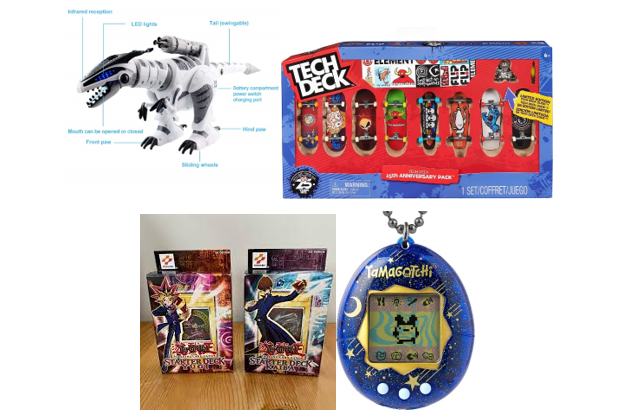
Of the images above, I had the bottom row, and got far more use out of those trading cards than most of my other toys, something I was reminded of by yet another of the endless resurgence of meme clips from the Yu-Gi-Oh anime appearing in my YouTube feed. Which brings me to the topic of today’s article, the commercialist dystopia that series took place in. While seemingly everyone ever has seen the first episode of the series, for anybody that doesn’t recall, Yugi, Kaiba, and friends live in a world that more or less revolves around their favorite trading card game, something that is taken to progressively more insane lengths with each passing season (and the various sequel series which I’ll briefly touch on here), to the point that first sequel, GX, listed the game next to politics and the economy as the primary pillars of society. Obviously this is all a good excuse to keep making a dumb, if fun, show that sells trading cards, but looking back on the series in 2023, it and its world, which was constantly derided as unrealistic, was an unfortunately accurate predictor of modern times in many ways.
The Yu-Gi-Oh manga was written by Kazuki Takahasi, starting in 1996. While we all remember it for the card game it produced, it actually didn’t start with that focus. Early on, the manga featured its core characters (Yugi, Joey, Tea, Tristan) jumping from one new gaming trend to another each chapter, with short arcs focusing on trends of the time such as laser tag, virtual pets, tabletop roleplaying games, etc. Each issue would see the friends jumping from one trend or brand to the next, seemingly forgetting whatever they’d been obsessed with last week as the hot new thing released. As a child who was assaulted by that same kind of advertising in my early years, I can only assume that Takahashi directly looked at all of these concepts he saw advertised to the world, the obsessive branding and barrage of new trends and fads, and wrote the characters as people who were extremely vulnerable to such advertising. Given that this manga’s release coincided with that of the first Pokémon games, its hard to say that one such trend wouldn’t eventually take over the world in its own way, which is what happens in the manga when the gang meets eccentric billionaire Seto Kaiba and learns of his favorite trading card game, which would eventually take over the series and become its primary focus. This game would not just be a breakout star of the manga, but would leak into real life as one of the most popular games in the world. It saw all the same types of ads that the manga had satirized at the time, and is still going strong today. Case in point, Master Duel, the Steam Yugioh simulator released in early 2022, saw over 20 million downloads in the first month.
While the characters in the show treat this card game as the ultimate serious business, with their dramatic flourishes, card game enhancing holograms, ridiculous prize pools, and world-ending threats combatted by trading cards, is it really that far off from some of what happens in real life? After all, the real-world game caused violent riots that hospitalized several people when the famous Exodia cards were released, a behavior that almost mirrors the anime’s third episode, when Weevil Underwood throws Yugi’s Exodia cards into the ocean, prompting violence and somebody’s near drowning. This would only be the first of several mirrors between the real world and the nonsense land of Yugioh. While it was almost certainly intentional, early villain Pegasus, the in-universe creator of the card game, is clearly a mirror to real life media moguls like Walt Disney. What other cartoon-loving American businessmen would not only create their own private world to invite people to partake in an area dedicated to a particular product and brand they like, but model it perfectly with a castle in the middle? A private little world that basically functions as a self-sufficient, sovereign city where guests just indulge in the requisite media during their stay? Utterly ridiculous.
Disney might be a wide enough brand for this, but we shouldn’t pretend that narrower brands aren’t going the same way and building their own Duelist Kingdoms. The Wizarding World of Harry Potter in Florida certainly comes to mind. As do the various conventions and gatherings of people in search of others who really like their favorite piece of media. ComicCon and its ilk existed before Yugioh, but I am once again convinced that Takahashi was on to something when he built his strange, yet familiar world.
Pegasus would inevitably be accompanied by the aforementioned Seto Kaiba, a genius billionaire celebrity who seems to be a household name all over the world due to his eccentric tastes, strong branding, and fascinating if not always useful technological advances. There’s many parallels to be drawn between him and real world celebrity billionaires like Elon Musk, though the animated character with a sad backstory will somehow always be the more likable entity, if only because we don’t have to deal with him in the real world. Kaiba takes his love for the game to comically absurd levels, with his obsessive heights reaching the private jet plane modeled after his favorite card and his renting out large portions of a city to host a tournament in season two. Obviously we’re a bit more reserved with such things in real life, limiting these things to massive convention centers instead, but anybody from a city that hosts a major convention will remember seeing floods of people intent on just their own thing walking the streets for a weekend. As somebody who’s been to PAX East and Anime Boston, I can’t find the weekend of nonstop games on rented streets that made up the Battle City arc too ridiculous anymore.
Naturally, the giant holographic arenas from Pegasus’s island couldn’t just be inserted into a city, so Kaiba went out of his way to invent the duel disk to let the characters throw down in holographic card games anywhere at all.
I had one of these things as a kid, and let me tell you, they kind of sucked. The cards got bent often trying to stick them in the slots, and standing across the room like you were in the show meant that you both had to walk over and read each other’s cards at weird angles every thirty seconds. But I still had one of them, and a decent chunk of my friends did, because advertising works and a few good ads and a fun television show made them look like the coolest things ever to gullible seven-year-olds. Of course, they didn’t come with actual holograms like in the show, because they were ultimately just fancy pieces of plastic. Of course there was never going to be an affordable product that let you see your favorite little monsters in the real world and fight your friend’s favorite little monsters. Oh wait.
Exactly that did happen. The hologram technology might not be here yet, but in every other way, Pokémon Go is the duel disk. Everybody has the tech needed on hand to pull out their favorite creatures and throw down literally anywhere. And if you didn’t, then it was because you chose not to download it, not because you didn’t already have access to the thing every single person is carrying with them, just as every single character carried a duel disk strapped to their arm. With the slow rise of VR technology, we aren’t even that far off from the ability to play out one of those nonsensical anime duels with the monsters in front of us if we really want to. Thank you, eccentric billionaires with a big interest in one thing and profits.
Now, the card game getting turned into a pro sport is obviously too far gone from reality. There are characters like the aforementioned Weevil Underwood who more or less build fake personalities around the game and their preferred gimmicks, building up loyal fanbases who really only know them through parasocial relationships. We see it clearly when Weevil’s able to get random kids to do him favors during Battle City because they like watching his matches, or when he and fellow card game gimmick celebrity Rex Raptor walk down a street, waving to fans. There’s high stakes on these card games, with characters like Mai Valentine explicitly making her living off tournaments.
And frankly, if you can afford to drive around in a convertible and fly trans-pacific to attend socialite parties with Hollywood stars off nothing but your card game winnings, you’re doing pretty well for yourself. Thankfully, there’s no equivalent to this nonsense in reality. Sure, we have pro sports and WWE and all that, but those are built for it and require an impressive degree of physical ability, so it’s not as though people all tune in to watch somebody play a game they could actually play just as well themselves, right?
Oh yeah, we absolutely did create a multi-million dollar industry around watching people play video games on the internet, sometimes including the aforementioned Yugioh Master Duel. With the rise of VTubers and internet personalities, it’s hard not to see the likes of a Weevil or a Rex in the real world. Their gimmicks aren’t all that different from what a pro wrestler might do, and we all remember the era when John Cena was among the biggest celebrities in the world. Hell, one in three kids want to be a YouTuber or streamer as their career right now, so it’s not as though the parasocial aspects shown and the desire to follow in the footsteps of these pseudo-celebrities is uncommon. The sequel series, GX, takes this concept a step further with Duel Academy, the school Kaiba uses his infinite money to open, which primarily teaches the card game and trains kids to go pro in it. There’s a character who claims to have a PhD in the game. And while this was purposefully over the top nonsense that we all laughed at in 2004, is it really that strange now? It wasn’t that long ago that people started hiring Fortnite tutors, and that’s before we get into the fact that accredited colleges have eSports programs and scholarships now. Duel Academy is often seen as the point where the series finally jumped the shark and got too ridiculous to take seriously (well, maybe that was when they started playing on motorcycles for some), yet there is once again a real world mirror in the modern day.
What am I getting at here? That while we all laughed at it once, the card game themed dystopia that is the world of Yugioh isn’t all that far off from reality. Sure it’s not one thing, and it isn’t always a card game (though sometimes it is), but this idea that commercialism doesn’t slowly redefine the world is wrong. We see people incorporating media they like into their identities online (if you’re online enough to find this blog, you’ve probably done it too), and we really do create havens for people that love a certain thing. We really do invest into games as an industry and job and have these parasocial relationships. It’s important that we all remember that the advertising around us works, and that we need to take a moment to smell the roses, touch some grass, and not think about media/celebrities once in a while. You can argue that this is all just an extension of what professional sporting events have always done, but the fact of the matter is that while we all laughed at Yugioh for having an utterly ridiculous world, we’re all living in that world, whether we recognize it or not.
Now, to my knowledge, we’re not totally far gone. We still don’t have the US military drafting card game players for world defense, and there aren’t people going around trying to rewrite the history and culture Egypt in their own image…
Well, at least the military thing hasn’t happened yet.
 Nerdcrash!