Dungeons and Dragons started out as a tabletop roleplaying game developed by a small company consisting of a handful of individuals. Now it is a giant IP that dominates the genre and has influence in other media. Movies, TV shows, books, and videogames all have projects that build off the lore and worlds of the Forgotten Realms; Dragonlance and Eberron have strengthened the property that was once a small niche hobby. These days Dungeons and Dragons is in the public eye, thanks to the success of the 5th edition, live stream gameplay, and the recent Dungeons and Dragons movie that received both critical and consumer acclaim. However recently Dungeons and Dragons has struggled with videogame adaptations. Their MMO that takes place in the Forgotten Realms has aged poorly despite updates to keep it going, and Dark Alliance flopped badly due to balance and terrible gameplay. Enter Larian Studios, who aims to save D&D’s videogame market with a project that will revive an old title.
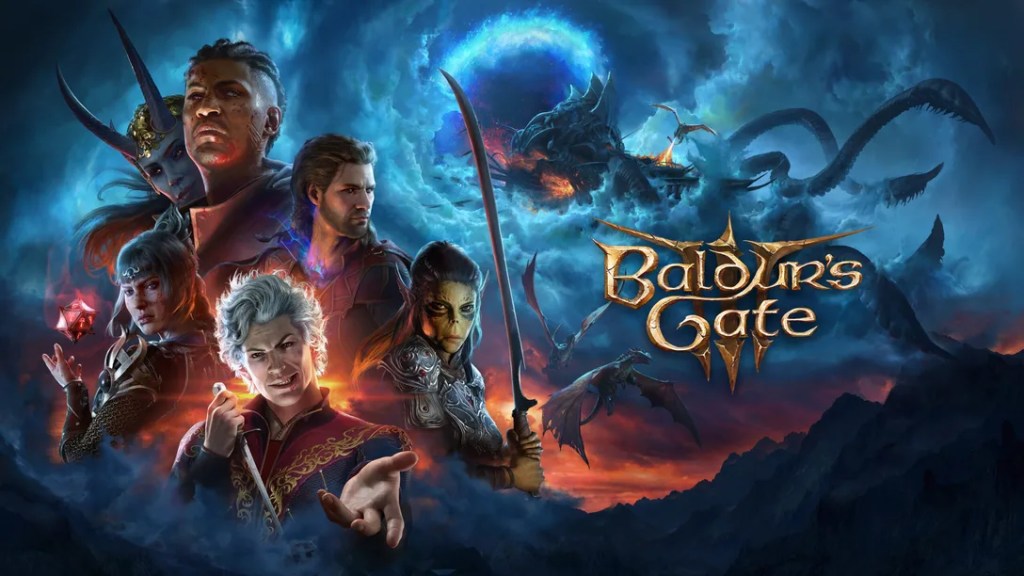
Baldur’s Gate 3 is a spiritual successor to Baldur’s Gate 2 that was developed and published by Larian Studios. Baldur’s Gate 3 is an isometric RPG that follows the traditions of previous titles in the franchise. The game follows a group of adventurers each with their own backstories and interests as they fight an incursion of mind flayers and a secret plot in and around the titular city of Baldur’s Gate. I played the game on PC for over 100 hours, around 70 hours in a singleplayer campaign and around 30 hours in a multiplayer campaign.
Game reviews done in my style are organized into five categories, with each being graded on a scale from one to five. At the end of the review, all the categories will be summed up to determine the game’s letter grade. The five review categories include: gameplay, story and characters, visuals, soundtrack and sound design, and quality of life. Gameplay is game and level design, the quality of the combat, traversal mechanics, and skill tress. Story and characters judge the narrative and character development. Visuals discusses the quality of the graphics and art direction. Soundtrack and sound design looks at the original score, sounds, and ambient music that fills the world. Finally, quality of life grades the game on user interface and game stability.
Gameplay
Baldur’s Gate’s gameplay, at its core, follows the mechanics that are set forth in the Dungeons and Dragon’s 5th edition. It contains all the classes from the player’s handbook and the core races while adding in duergar and gith. Dice rolling and chance is a core mechanic in everything from persuading guards, to combat, to learning about the world; it all revolves around rolling a d20. Now leaving things to chance may seem like a poor gameplay decision, however, failing a check isn’t the end of the world. Checks at worst prevent a peaceful resolution or miss out on a piece of history or insight on a person. If the player really wants to pass a check there are opportunities to reroll through inspiration and items and spells to boost a number.
Movement involves clicking around the map and the battlefield through a top-down perspective. The player can send a character almost everywhere with the ability to climb, jump, or fly (if the spell is available). Looking over the battlefield brings up my first flaws with the game. I personally have some problems with the camera. I had some instances where the camera went off on its own or got stuck in a spot. It was more of an annoyance than a problem.
Combat in the game is turn-based (but can be real time if the player wishes it) featuring an initiative turn order that is ever present at the top of the screen. This offers a strategy to control the action economy by killing enemies on the eve of their turn. Combat, mechanically, mostly follows D&D rules with some modifications, such as going prone automatically ending a turn (P.S. I hate this rule change). The best part, however, is using elements of the map to your advantage as it adds a dynamic to combat so that it isn’t the same each time. Shoving a goblin off a cliff into a pit of spiders, erupting a room using fire bolt on an oil barrel, and climbing to the rafters of a tall amphitheater to rain arrows down on enemies with sneak attack; all of these are scenarios I was able to pull off in the game and there are plenty more! Igniting a grease spell, using darkness or silence to stop magic users, grouping up enemies for a huge fireball. The possibilities are endless! A huge shoutout to the engine and coding that went into this plethora of options!
The final piece of gameplay that I should discuss is character creation. Now normally I am someone who doesn’t spend a long period of time in character creation. I try to create a character that usually resembles me and be satisfied with that and move on. However, Baldur’s Gate 3’s character creation is like making a D&D character for obvious reasons. Selecting a class, background, and race provides different attributes and abilities that if combined with others can lead to powerful combinations. In addition, every fourth level, you get to choose a feat that adds even more to your character. The character I built is a barbarian that is a master of dual wielding. Basically, the strategy was simple; go face. Of course, if you didn’t want to create a character, you could choose one of the pre-created characters that become your companions in the game if you don’t select them, more on them in the next section.
Overall, the dynamic gameplay is to be applauded. Encounters range wildly in difficulty from the very easy to pulling out my hair; only three fights gave me a real challenge. But the different levels of difficulty is a nice change in pace.
Baldur’s Gate 3’s gameplay score is a 5/5.
Story
The story of Baldur’s Gate 3 is that out of a mind of a Dungeon Master; the adventuring party is captured by mind flayers and are tadpoled, but when gith dragon riders attack they are set free! From that moment this band of misfits and outcasts must work together to cure themselves or else transform into the monsters that disrupted their lives! The goal of finding the cure is ever present and is the main motivation for the characters to progress down the story. It is also an open enough story that allows the player to have any character enter it and not feel out of place. From this beginning, the cast decides on a conflict between goblins and druids, converse with a hag, fight gnolls, make deals with a devil, and dive into the Underdark. And that is all in the first act!
From here the plot thickens, turns out the mind flayers’ hivemind, the Elder Brain, is being controlled by disciples of the Dead Three, the gods of death in the world of the Forgotten Realms, and the true antagonists of the plot. Basically, they want to take over the Sword Coast and create a new order for their gods under the name of the Absolute. You know, normal high fantasy villain plots. The goal of the cast is now to wrest control of the Elder Brain from the Dead Three and decide the fate of the realm.
In the final act, the cast travels to the titular city of Baldur’s Gate and delves into the city’s depths to find allies in their plight in eliminating the Dead Three. But in doing so they set free the Elder Brain, which then tries to take over the world. This leads to one last climatic fight against the ilithid (mind flayer) forces to save the day!
I wanted to avoid the more detailed story notes in this section because I truly want people to experience this game. Just know that on top of the main story there are companion side missions that span the entire length of the game and fun side quests that provide funny and unique encounters or awesome loot to help you in battle. There is so much content that a player can play again and find new content they didn’t encounter before, plus the plot is choice heavy and your choices have consequences down the line, so the replayability is there.
The best part of the game, in my opinion, is interacting with the cast. The mysterious and estranged Shadowheart; the smart and curious Gale; the heroic Wyll; the stoic Lae’zel; the dastardly and charismatic Astarion; and of course, the best girl, the muscle mommy, and my romance choice, Karlach. Yes, she is that awesome and I will die on this rock. Don’t insult Momma K. Then you are joined later by Halsin, Jaheira, Minthara, and Minsc. All of these characters have their own backstories and motivations in the game and if you go against them too much, they will leave the party, or worse, fight against you. Their dynamics help in a fight and in conversation as often you can let them make their own choices in their story, which I often do. Each of the companions add weight and a variable to the story that makes it change and also gives the player grounded characters to talk to and form bonds with. I easily made a bond with each of the companions and not only did I want me to survive, but each of them. The cast of Baldur’s Gate 3 is the best in gaming that I have encountered. They are that good.
Baldur’s Gate 3’s story gets a 5/5.
Visuals
Graphics and the visuals are the weakest area for Baldur’s Gate 3, though that is not to say they are poor. Character models and armor designs are the game’s strength graphically. The colors are vivid and well shown on the clothes and armor, while not appearing out of place. The character models are well designed with a particular strength to the faces of the characters. Of course, more attention is given to characters with speaking roles and in particular the main cast. Baldur’s Gate 3 utilized motion capture for the 248 actors in the game, so in cutscenes and conversations not only are you hearing the actors’ voices, but also their physical performances. The motion capture adds an element to the game that helps its realism and makes conversations that much more immersive and engaging.
The environments of Baldur’s Gate 3 are beautiful and well thought out, but aren’t revolutionary or ground breaking. Structures like buildings and homes and shrines are a bit iffy in presentation. Lighting is fine and enough to keep everything visible. Backgrounds do just enough to not be a distraction and occasionally add something to the story or combat.
Baldur’s Gate 3’s graphics gets a 4.5/5.
Soundtrack and Sound Design
Baldur’s Gate 3 features the best videogame soundtrack that I have heard in years. Composed by Borislav Slavov, the game’s soundtrack has countless hits. We have “Down by the River”, “Raphael’s Final Act”, “Twisted Force” and “The Power” are all songs that I willingly listen to in my free time they are that good at being earworms. They bring a variety of instruments, vocals, and effects at just the right time to make key moments in the game that much more intense, or sad, or blood pumping awesome. I tip my hat to Slavov and wish him luck at the Game Awards and hope he gets the gold. On top of the soundtrack the game has wonderful sound design and ambience. Each location has a different mix; city sounds in Baldur’s Gate and sounds of a cave while spelunking in the Underdark. The sound quality isn’t jarring, but instead provides a wonderful moment to close your eyes and just imagine you are in the game.
Now I have to talk about the voice acting. It is Grade A stuff. It is amazing. The entire cast give strong performances, from Neil Newbon (Astarion), Amelia Tyler (the Narrator), Devora Wilde (Lae’zel), Samantha Beart (Karlach), and Andrew Wincott (Raphael). On top of that we have performances from some of the best voice actors at the top of their game with Matthew Mercer, Maggie Robertson, JK Simmons, and Jason Issacs. All these actors provide such range and talent that brings their characters to life; not only in vocal performances but physical performances as well.
Baldur’s Gate 3’s sound design gets a 5/5.
Quality of Life
When it comes to quality of life, Baldur’s Gate was a little rough during cut scenes. The occasional clipping, a character model standing through an object t-posing, you know the usual bugs. The best thing is that Larian Studios fixed these problems really quickly. A Day One patch got rid of most of these problems and other hotfixes. Larian Studios actually keeps an ear close to the community and adds content to meet their needs. Not fix. Add! Karlach, a very popular character who got a very sad ending where she dies from her demon mechanical heart, was given a life where you can join her in the hells to continue living. They added a magic mirror to change your character’s appearance at the campsite. New cutscenes, new visuals. And Larian hasn’t stopped. This much free content that the community asks for in a short period of time earns my respect. A constantly improving quality of life for the game’s community. All of this for a $60 price tag, a hundred hours of content and solid gameplay? Money well spent.
Baldur’s Gate 3’s quality of life gets a 5/5.
Final Verdict
Baldur’s Gate 3 is the peak of the gaming year in my opinion and 2023 has been a boon for gaming with so many strong titles pushed out throughout the year. But I think Larian did something very special here. In an industry where huge company’s push out lifeless sequels, DLCs transformed into full games, and microtransactions, Larian went back to gaming’s core and produced not only solid gameplay that took some risks and changes with the isometric genre, but also a strong story. Baldur’s Gate 3 is a work of art and is the pinnacle of gaming that other companies have to strive for now. Whether they like it or not.
The final score for Baldur’s Gate 3 is a 24.5/25 or a A+. My clear choice for game of the year.
 Nerdcrash!