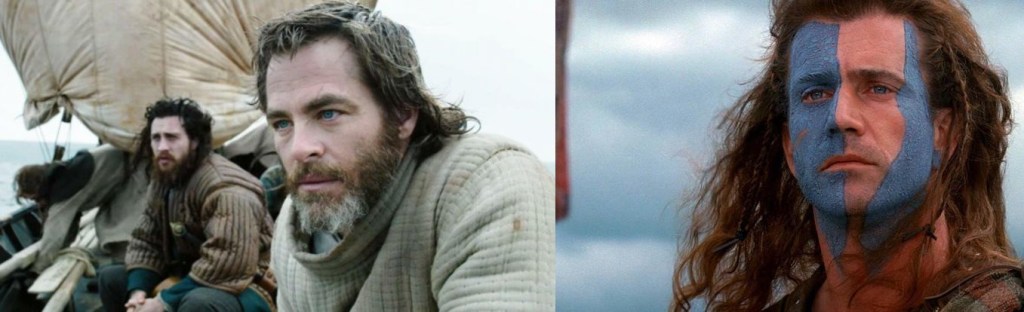
So far on this blog our discussion of nerd-like topics has surrounded fictional sources. But for me, another area where I geek out over is history. I’m a huge history buff, especially regarding military history. The Napoleonic Wars, the medieval era, and the World Wars are my favorite periods of history to analyze. For this article, I want to begin a new series for the blog where I look at movies and TV shows and look at how accurate they are. There are plenty of YouTube videos that do this exact thing and I immensely love them, but they also critique fictional stories. Like for example the Siege of Minas Tirth. For this I’ll be looking at solely historical films and/or period pieces. Fantasy analysis and comparing it to the real world is hard because sure historical military theory can apply to human nations, but not orcs, goblins, or dragons.
For this article, I’ll be looking at Braveheart and Outlaw King, two films that look at William Wallace and Robert the Bruce, two men who were key figures in the First War of Scottish Independence. I recently visited Scotland over the summer and learned a lot not just about my heritage but about this conflict. I visited Edinburgh and Stirling where key battles were fought. I then watched these two films in succession, because in the historical timeline they follow after each other with Braveheart’s events happening first, then followed by Outlaw King.
Looking at Braveheart first, the basics are that Mel Gibson plays William Wallace as he leads a revolt that turns into a full-scale rebellion against the English crown because Edward I, also known as the Longshanks, allowed English placed nobility to rape newlywed women. Before going further, I should mention how Edward I got dominion over Scotland. The previous Scottish king, Alexander III, died and left his three-year-old daughter as heir, who then died on transit from Norway. This left Scotland without an heir. Scottish nobility then argued who should then become king and asked Edward I to mediate the choice. Edward I, in return, demanded that Scotland be governed under his overlordship. The Scots thought nothing of this until Edward I started to levy men and tax them. The English then invaded and sacked the city of Berwick in the first phase of the war, which is often overlooked in Hollywood. As for the rape of newlyweds, that part isn’t true, there is no evidence to support this at all. Now, William Wallace did lead a group of peasants in a rebellion, but the key part that the film doesn’t include is that he didn’t act alone. He was joined by Andrew de Moray, who was the main organizer of the rebellion. Sadly, he died in the famous Battle of Stirling Bridge and all the credit passed to Wallace.
Let’s look at that Battle of Stirling Bridge that is depicted in the film. In the film, the battle takes place in an open field and the Scots are dressed in kilts and ragged furs. This is completely wrong. The Battle of Stirling Bridge took place at a river crossing, there is no river in the film or even a bridge! There was a prebattle meeting between the two sides, like in the movie, though it was more focused on preventing a fight instead of bribing the Scots. What happened is that the English started to cross the bridge, but before they could get across, Moray and Wallace charged the English. There was no cavalry charge like in the movie because the Scots were the ones charging. The English were thrown off and couldn’t form up to deflect the attack, and that disorganization caused them to lose the battle. Plus, many English died because they drowned in attempts to flee the battle. As for the issue of Scottish battle uniform, they didn’t look like barbarians. If anything, they look more or less the same as the English. They share similar military tech and culture, so there would be little difference, and this made battles between the English and Scots confusing and bloody.
After the Battle of Stirling Bridge, according to the movie, Wallace raided and laid siege to the city of York and even captured it. Yeah, no. This never happened. Did the Scots raid farmland just over the border into England? Yes. Wallace led raids in northern England during the back half of 1297. But York was too strong of a fortress. York, during the time of the war, was a foreboding fortress city and a siege would take a long time, something the Scots didn’t have. I should also say that Wallace didn’t have a love affair with the wife of Prince Edward, Isabella of France. The two have never met. It is obvious that part is fictional, but I thought I should bring it up just in case.
After all that fictional plot, the movie moves to Wallace’s defeat at Falkirk. It should be stated that in the lead up to this battle, there was political strife between the Scots, particularly between Robert the Bruce and John Comyn, the two leading candidates for the Scottish throne. Wallace, meanwhile, wasn’t sieging York like in the movie; he was in mainland Europe trying to find allies in their plight. He mainly went to France and the Papal States. The Pope condemned the English invasion. Now here is something that the film gets right. Edward I was in France expanding the realm, when he heard of the English defeat at Stirling Bridge, he made a truce with the French and returned to England to muster an army to respond to the rebellion. The actual battle is very different from the movie. In the movie, Wallace poured oil in the field of battle and lit it on fire to separate the English force. This is pure fiction because Hollywood loves to add fire to everything. The battle also didn’t have Irish conscripts switch sides mid battle. The Irish were involved in the war, but mainly fought on their own island. The actual battle is less thrilling than the movie. The English just rained arrows and projectiles onto the Scots using the superior longbow. The English cavalry and infantry pinned the Scots and subjected them to the archer onslaught. Wallace did manage to escape, however.
The final act of the movie depicts Wallace getting revenge on the Scottish nobles that betrayed him at Falkirk and getting captured, then executed. Post Falkirk, historians aren’t exactly sure what Wallace did, but I don’t think he went around slaughtering nobles. That is because he wasn’t betrayed at the battle, that would come later. It is believed that a knight in his retinue turned Wallace over to the English. Wallace was then taken to London for trial. He was tried for treason and found guilty, then starting from the Tower of London, was stripped naked, hanged, emasculated, and then finally beheaded. This is something the film got right to an extent, though the reality of the punishment was more brutal than depicted, but since the film would need to be able to be seen in a theater, I’ll give it a pass there. Braveheart, though an entertaining movie, isn’t that historically accurate. The film was more inspired by the myth of William Wallace than by the actual story.
Now let’s talk about Outlaw King. Here Chris Pine plays Robert the Bruce as he fights for Scottish independence as its king. The movie opens with the siege of Stirling castle after the Battle of Falkirk. There, Edward I invited all Scottish nobility to swear fealty. The garrison at Stirling wanted to surrender, but Edward denied it because he wanted to show off his new siege engine. Now, the film depicts Robert the Bruce as a kind individual who puts the people before himself, a noble figure. But the reality is he was just another ambitious noble who was seeking the throne. During the siege of Stirling, the Bruce met with English lords to discuss the possibilities of him getting the throne and made some alliances. Now outside of including that secret meeting, the film largely got the opening right. One theme that the film has, an intense rivalry between Robert the Bruce and Edward’s heir, the prince Edward, wasn’t valid. If the film wanted a rivalry to feature, they should have given more attention to the Bruce versus John Comyn. Instead, the film kills Comyn off early before the Bruce takes the throne. Now, the Bruce did stab Comyn with a dagger. Bruce’s secret alliance became known to Comyn who then informed Edward I about the plot. In anger, the Bruce met Comyn at a church to confess, but he refused. The Bruce then stabbed his rival in anger but didn’t kill him. It was his attendants who came to the scene after and found Comyn still alive, who killed him.
Other parts of the first act of Outlaw King are accurate. Elizabeth de Burgh, played by the wonderful Florence Pugh, did become Robert’s second wife, and his family dynamic with his new wife, daughter and brothers is accurate, although it didn’t mention his sisters or nephews. But that would have added too many characters, so a valid cut there. Robert also had the support of the Scottish church and was crowned at Scone, where all Scottish kings are crowned. These things the film showed accurately.
After the Bruce’s coronation, he led an army against an English army led by the Earl of Pembrooke, Aymer de Valence, who under orders from Edward I was to offer no mercy. The two sides would meet for the Battle of Methven. Outlaw King depicts this as a night ambush after de Valence, refused to fight the Bruce because it was a Sunday. This isn’t exactly how the battle went down. The two sides did meet before the battle, but de Valence refused to fight because it was too late in the day for a battle. The Bruce then moved his army six miles away and set up camp. The Earl of Pembrooke then lead a dusk time ambush and defeated the Scottish army. The use of fire arrows in the movie is also a fantasy because once again, Hollywood loves to use fire. It is more effective to not light arrows aflame.
According to the movie, after his defeat at Methven, the Bruce went on the run and was declared an outlaw. In the movie, the Bruce fled and hid in the Scottish Isles for the winter, historians aren’t sure if this is true as there are no records of his destination. What is true is that Edward II, the prince, did capture the Bruce’s castle of Kildrummy and a few days later captured his family. After the winter, the Bruce led a guerilla war against the English, capturing castles occupied by the English and then destroying them. This is depicted in the film and although there are some minor inaccuracies with the methods of how it is done, the film does a good enough job in representing these events.
The climatic battle at the end of the film is supposed to be the Battle of Loudon Hill. In the prebattle scenes, Edward I is leading the English army back to Scotland before he dies of disease. The historical reality is that Edward I’s death occurs after Loudon Hill, not before it. He did die on the road to Scotland (with the disease being dysentery). The crown prince, Edward II, who is depicted as being at Loudon Hill, also wasn’t there. For the battle itself, I find it to be one of the more historically accurate battles depicted in film. The Scottish did choose muddy ground at the foot of the hill on purpose to bog down the English cavalry. In the film after the initial charge by the English, which is stopped by ditches and the mud, the battle devolves into a scrum and a series of smaller clashes. Generally, this doesn’t happen in medieval battles, units keep rank and battles are more like pushing and shoving matches with only the men in front fighting. Loudon Hill would mark the turning point in the war and years later at the Battle of Bannockburn, the Bruce would lead one final victory against Edward II to secure Scottish independence.
Braveheart is easily the less historically accurate of the two films, as it plays more on the myth of William Wallace. Outlaw King, though its representation of Robert the Bruce is far kinder than he was, depicted the correct order of events and is more accurate overall. Both films depict a major battle and an important event in the Scottish culture, the films build off the American connection of independence from England, which makes it popular for Hollywood to make films about. It should be stated that both heroes in each film weren’t perfect and have done things that are frowned upon today, but they did it for a dream of an independent Scotland and although Scotland is just a part of a greater United Kingdom today, they won in the end, for their descendants now sit on the throne of England.
 Nerdcrash!