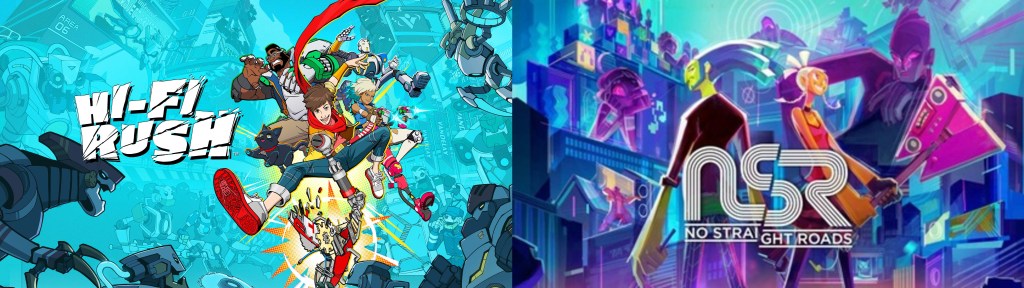
Today, we’ll be taking a look at a pair of similar games that both came out of nowhere. The first is Hi-Fi Rush, the surprise hit from Tango Games, and the second is No Straight Roads, Metronomik’s debut title. Coming out within a close timeframe, and on some of the same consoles, these titles are both musical 3D beat-em-up/character action games about taking down a corrupt tech corporation run by a team of six colorful individuals, and both feel like they came right out of the Playstation 2 era. It’s an overly narrow description, so you can understand how coincidental their coming out within a year of each other is. On that note, “musical assassin/fighter” is one of my favorite character design tropes, and if my past articles hadn’t given it away, I love character action games, so I greatly enjoyed both of these and wanted to do a joint review between them to see how the same idea was done very differently by two companies.
For starters, let me set the scene (no spoilers) for both games. Hi-Fi Rush is the story of wannabe rockstar Chai, who volunteers for an experimental prosthetics program, winds up with musical/magnetic powers as a result of an accident in the process, and then teams up with several disgruntled employees to take down the company responsible when it’s revealed that there’s a remote-control chip in all of their prosthetics. No Straight Roads sees the rock duo Mayday and Zuke living in a city where the titular company/record label can convert musical performances into electrical power; they audition for roles on the label and are unfairly rejected because their boss is only accepting EDM artists, even though that is causing power failures across the city. Both games then lead to a path of musical violence, where you use a guitar and/or other instruments to fight your way through the villainous company of choice. In Hi-Fi Rush, you’re taking down the company’s leadership to get more information on their projects and eventually stop their nefarious scheme. In NSR, you’re taking down each of the label’s top artists to prove your worth, and eventually challenging their president for control of the city’s power grid. In both cases, you’ll be picking up some new friends and techniques along the way.
In most games, the meat is the gameplay. In both of these titles, I think the meat is actually in the style. That said, it’s easier to explain that point after we go over their gameplay, so let’s talk about that first.
Hi-Fi Rush gives you control of Chai, who fights with a scrap-iron guitar and a grappling hook on his artificial arm. Chai controls in a way that will be very familiar to Devil May Cry fans, actually playing a lot like a slower Nero. Your goal is to zip between enemies, pulling yourself toward them with the grappling hook, and mix light/heavy attacks to combo to the beat of the background music (with an optional visual indicator for those who need it). As you go through the game, you can buy more techniques and combo chains in the store using scrap dropped by enemies and will recruit assist characters who can be summoned to aid you, with each character having a separate cooldown so that you can chain their abilities together in creative fashions. I would like to say that this encourages a very freeform combat experience, but that’s not quite the case. For all the options available to you, they’re very limited at the start. Chai’s base moveset is very anemic, and you have to buy the ability to do basic things like a light-heavy-light combo. As a result, you’re barely capable of anything early on, and Chai won’t start feeling like a proper action protagonist until more than halfway through the game. Most games in this genre require you to buy character upgrades/new moves with enemy drops as you go, but I’ve never seen a game make you buy basic three-hit combos before. Typically, you’re getting special moves like Dante’s Stinger or Bayonetta’s Witch Twist, but Hi-Fi Rush actively prevents you from doing anything beyond a basic 3 hit light-light-light or heavy-heavy-heavy combo until you unlock each possible combination of attacks, in addition to the expected special moves (Guitar Ride, my beloved). Unless you’re purposefully replaying levels to grind for cash, these restrictions will last a little over half the game. Additionally, there’s several enemy types that require a certain assist character to hit them before they can be damaged. This is fine on its own, but some enemies, particularly those with Macaron’s Z-Shielding, demand this multiple times, so the pace of the gameplay occasionally grinds to a halt while you wait for the right assist to recharge. This would be less of an issue if dodging were a more active task, but Chai’s invincible dash and superior mobility invalidate most non-boss enemies with little effort. While I have my complaints, I still really like the combat once you’ve unlocked all the essentials. Late-game, you’re doing wacky custom combos and juggling enemies with your assists while ziplining into them at your leisure, and the combat feels really good once you’re finally allowed to use all your mechanics. The highlight of the combat system is synching your attacks to the background music. Your attacks always hit on the beat to maintain the game’s visual style, but if you input the attacks off-beat, you deal less damage, which is the perfect way to combine rhythm game mechanics with character action, encouraging you to interact with the game’s systems instead of just button mashing. This is so prevalent that I found myself unconsciously timing jumps and navigating the pause menu to the same beat I attacked to. Outside of combat, you’re doing some basic platforming, with the occasional puzzle requiring the assist characters’ abilities.
Meanwhile, over in No Straight Roads, you have two characters to control at once: Mayday the guitarist and Zuke the drummer. Each character has their own health bar, and slowly heal when you aren’t playing as them. The one you’re not currently controlling typically just follows behind your current character, but they each have gameplay differences that become more apparent the further into the game you go. Mayday acts as the power character, relying solely on her three hit guitar combo and homing projectiles, eventually gaining the ability to cause AoE shockwaves by holding the attack button to end a combo early. Zuke is more combo-oriented, starting with a basic three-hit using his drumsticks, but gains more hits per combo as you go, dealing massive damage on the final hit if you do all his attacks in rhythm, and having the ability to cancel out of his combos into a dodge. He also has the same homing projectile as his bandmate but can hold noticeably less ammo at a time. These abilities, as well as some other goodies like super moves and shared mobility options, can be purchased using points from boss fights. Each boss scores your performance on various factors (time, damage taken, how well you use the parry system), and gives you points for the store so that you can upgrade your characters between gigs. Their abilities run into an admittedly awkward situation, however. While they’re useful against most basic enemies, bosses are almost exclusively fought with either melee or projectiles, meaning you almost never get to use a character’s full moveset at once. I also found that Zuke is the much stronger character after a few upgrades, but that might just be that his dodge canceling fits my playstyle better. Whereas Hi-Fi Rush had full levels, NSR is effectively a slowly expanding hub world where you can run around talking to NPCs and doing quick side quests for a few extra points. The actual levels consist of small platforming challenges with some basic enemies, straight into the boss fight. As a result, you can probably 100% NSR (sans perfect scoring the bosses) in a little over five hours, while Hi-Fi Rush has noticeably longer levels and a meatier twelve hour runtime. I should also note that NSR can be a little glitchy at times. It never interfered with the gameplay, but some of the movement options have weird environmental interactions, and I had one instance where a character just stopped responding to my controller in the hub world, prompting a restart.
Now as mentioned, the meat of these titles is the style. Both boast vibrant worlds filled with music in every direction you look, and sincerely impressive soundtracks. Hi-Fi Rush invests fully into the gimmick of “things happening to the beat” with Chai’s powers affecting the environment such that EVERYTHING in the game that moves is in perfect sync. I tried really hard to get just his walking animation to desync from the music, and it is impossible. This is a world controlled strictly by the beat of the music, down to basic movements, down to how you play, down to when enemies will attack. It wholly invests into this, and it consistently delivers on stylistic fun all throughout, with highlights being the funding bar when you try to bankrupt R&D, the Space Channel 5 section of one of the boss fights, and the music that overrides your usual songs when fighting the company’s CFO. No Straight Roads, meanwhile, has a visually stunning playground for you to run around in. Vinyl City is filled with creatively implemented neon colors, background characters whose appearances are based on different styles of music, amusing advertisements done by each of the game’s bosses, and a constant push-pull between eh glow of the living city and the impending blackouts that come from there not being enough music. It also has an incredibly creative set of bosses, who are the centerpiece of the game. Each one is a different style of artist who not only fights you based on their style, but is actively performing for the entirety of the fight. My personal favorite was the boy band who turn out to be mass produced robots in rubber masks, with cheer-powered shields such that you have to ruin their performance and heartthrob image to make them vulnerable. Each one goes so far into its own style as you encounter a DJ spinning the solar system as his turntable, a questionably sentient vocaloid in full control of her digital environment, and several others. The music is always at the center of the battle, as your intrepid rock band fights to override the enemy performances and background themes with their own. It’s so easy to make a game with just the essentials, or to invest into a realistic style, but both of these put all their effort into crafting unique worlds with details that are guaranteed to stick in your head.
There’s a lot to be said for the soundtracks of both games, but the long and short of it is that they’re both as strong as you would expect from games entirely about music. My favorites from Hi-Fi Rush are Fizzith and My Heart Feels No Pain, while the highlights of NSR are VS Sayu and Guitar Solo vs 1010. Hi-Fi has a mix of original lyrical tracks and licensed music, and while I sincerely like the bands they chose to license the songs from, I honestly think the original songs are stronger for where they play. There’s less of a focus on lyrical tracks in NSR, in case that matters to you.
Finally, we have to talk about their writing. Hi-Fi Rush is a decidedly funny game, with a cast of lovable goofballs who would fit right in as Saturday morning cartoon protagonists, and equally mustache-twirling villains. The plot is extremely straightforward and mostly exists to bounce the cast between departments. That said, every single character is likable in their roles, and even if they’re not the most well-developed of characters, they do their jobs in an endearing fashion with fun group dynamics and a constant sense of humor. NSR is working a more complex story discussing the politics of private companies taking over public interests, with a focus on how a tribalistic “us vs them” bias can prevent you from seeing the bigger picture. It spends more time developing its smaller cast of characters in spite of how short the story is and builds a lot of humorous situations out of its morally grey heroes. I think I laughed more playing NSR just because of the whiplash you get from the way some of the actors deliver lines. It also generally hits stronger emotional beats, and if you ask me to compare then I think NSR’s writing blows Hi-Fi Rush out of the water.
So where does that leave us? With two games worth playing, thankfully. I cannot express enough that both are PS2 games that were made on modern hardware, in terms of style, level design, length, and their general game philosophies. That said, I have a lot of nostalgia for that era of video games, and really appreciate both of them trimming the fat and being games that are unabashedly video games, with no worries about realism or not being taken seriously when they lean into video game tropes. Both are fast, well-constructed experiences. NSR is severely lacking in polish (it shows that it was a studio’s first game) and can be janky at times, but it has the heart and charm to make up for that. Hi-Fi Rush is, on an objective quality level, a better game with more replayability, especially once you unlock all the skills that really should have been part of your base kit. These two acoustic adventures were more than worth my time, and while I know it’s the weaker game, I must admit that I preferred NSR when all was said and done. It’s janky and much less polished, but I could really feel the developer’s passion for it as I played, and the fun plot, creative boss design, and surprising moments of pathos went a long way with me. Either way, these are both full of style, and if you happen to see either of them on sale in the coming weeks, give them a look. Both of them rock.
 Nerdcrash!