Following the success of the Adventure games, the series had an excellent and well-respected place in the gaming industry. Perhaps a better place than its parent company, given that the Dreamcast would be Sega’s final console. At this point, the Sonic series would have to continue on as a set of third-party titles, and while there was certainly an ironic preference for Sega’s long-time rival Nintendo (largely due to the GBA and DS being the only real handhelds at the time), other consoles would see a few games as well. Most notable about this era is that it was once again seeking to expand upon the franchise’s cast, in a move that would lead to many fan complaints about the series losing its identity. While I’m not wholly certain I agree with those complaints, it’s hard to pretend I can’t see where they come from. You expect to spend a certain amount of time playing as Sonic when you buy, well, a Sonic game. And that’s not what was happening here.
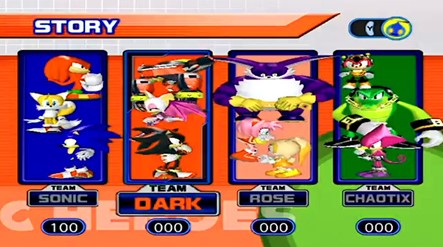
The main series follow-up to the beloved Adventure titles was none other than Sonic Heroes, which once again expands the playable roster while pushing the idea of multiple story modes. This game saw players tasked with controlling three characters at once, tapping a button to swap between characters focusing on speed, power, or flight, with one of each character assigned to the four teams you could play as. Team Sonic was the expected roster of Sonic, Tails, and Knuckles; Shadow and Rouge would return from Adventure 2 as Team Dark, now accompanied by the robot Omega. Team Rose consisted of Amy, Big the Cat, and Cream the Rabbit, who makes her main series debut after first appearing in the Sonic Advance games that were also releasing in this era. Finally, while Knuckles Chaotix wasn’t a particularly well remembered title, three of its characters, Espio, Charmy, and Vector, would return to the series as Team Chaotix (their other members eternally forgotten after this game). While this might seem like yet another ambitious run, creating twelve separate characters and allowing you to play as three at once, each in their own story, it’s not really what happened. A few minor differences aside, the characters of each role were virtually identical, meaning there were functionally only three characters in different coats of paint (with Espio’s invisibility power being the only real differentiator amongst the roster). Additionally, while the cutscenes explaining the plot varied, the four teams went through the exact same levels, with the endpoints being pushed farther back for the higher difficulty teams (Rose->Sonic->Dark). The Chaotix had their own mission-based style of gameplay that made them worth a look, since they had goals other than “reach the end of the level,” but these were still performed in the same levels the other characters were running through. So in other words, the game asked you to play through it four times (and complete the chaos emerald minigames that returned from Sonic 2) to see the ending.
I’m terribly nostalgic towards Sonic Heroes. I struggle to call it a good game, and in fact remember it as the first game where I was consciously aware of the glitches I encountered (a few too many moments where I died by falling through solid ground), but the game had excellent presentation and a certain charm to it. It’s other contributions to the series were a strange level up system each character had to redo each level, which thankfully remains trapped in this game, and changing the combat to a more beat-em-up style, giving enemies their own health bars instead of having them die in one hit. While this latter change was necessary to give the power characters something to do, it also slowed down the gameplay a bit, and would carry into several later titles, where it became much more irritating. This is a game I like in spite of its faults, of which there are many, but it is also the game that would start the fanbase’s debate over how much of a role Sonic’s friends should have in the series. A debate that was largely ignored by Sega, as they had made an interesting pair of choices regarding a certain character. Not only had they used this game to revive Shadow after his apparent death in Adventure 2, but they also had plans to give him a spin-off, believing his popularity would finally let them expand the franchise’s scope in a way Knuckles and Tails had been unable to. And well…
I really want to give this game an honest chance, given how much the internet has relentlessly destroyed it for the mere aesthetics (even if that is deserved). To that end… Shadow controls as well as he has in the past, and the gunplay is shockingly decent. I can also say… well, some of the levels are alright and… okay yeah let’s just get down to it this game threw away every chance it had to be actually good. In a strange case of Sega once again being ahead of the curve, they implemented a morality system three years before that would become such a big selling point for PS360 era games. It was a terrible system that allowed you to completely shift on a whim multiple times per stage, but it had one. And where you fell on it at the end of a level determined which one you went into next, which was an actually great idea.
Overall, there’s a great idea here, in letting the players put their own story together to see where Shadow ends up in the plot’s four-way conflict, with Eggman, new villain Black Doom, and the rest of the Heroes roster all popping in to try and steer him different ways. The problem was that there was a definitive true ending that throws this idea out the window to guarantee Shadow ends the game heroically. And to access this ending, you first have to see all ten of the other endings. Which means beating the game ten times, trying to map out your exact path to ensure you never miss an ending, replaying Westopolis far too many times since it’s always level one, and fumbling your way through every single mission in each level because you might end up on the wrong path and have to replay again if you mess up anywhere. Without a way to level select through these, it was a time-consuming process that makes even the good parts of the game wear down into a tedious mess. Oh, and a bit of dialogue aside, those ten endings are all small variations of just three endings, with only three final bosses, so even the supposedly unique endings get repetitive. I got through four playthroughs before I gave up on it altogether. And as if all of this wasn’t messy enough, the only way to actually learn the answer to the question of Shadow’s identity, which has been central to both this game and his plot in Heroes, is to reach the true final boss, and then purposefully stall for eight minutes to hear a secret line of dialogue explaining it. At least the music was great.
Following the massive backlash they received for this game, Sega took a step back. They had to consider the possibility that the ideal Blue Hedgehog Runs Fast spinoff was not a questionable morality quest filled with guns, warfare, PG swearing, and pointless motorcycles. Formulating a much better plan, they got to work on what would be, at least in spirit, Sonic Adventure 3. But it would be a little while before that game could release, so they filled the downtime with the aforementioned Sonic Advanced games and revisited the racing idea in the Sonic Riders series. And they made one other game.
Sonic Rush was just as much a side-game as the Advanced titles, but I want to give it a special aside for the simple fact that it introduced the Boost System. In a few more titles, when the franchise was in dire straights, the team would design a new way to go about controlling your speed, introducing a system where Sonic could “boost” at the push of a button, reaching his top speed instantly in an attempt to keep the game’s momentum flowing. Rush would be where the first version of this system appeared. It also brought in a considerable amount of goodwill in the wake of Shadow the Hedgehog, feeling much closer to a proper back-to-the-basics Sonic game, and only featuring him and Blaze (yet another new addition to the series’ roster) as playable characters. Blaze would dodge the ire directed at most of the new characters, partly due to her coolness factor, and partly because her gameplay was just close enough to Sonic’s while still being distinct that she didn’t take you out of the ‘Sonic Mindset’ in the same way that say, digging for treasure, going fishing, or firing a gun did.
This was the era that the Sonic franchise felt more like the Sonic & Friends franchise, now featuring some 15 playable characters across fewer games, with entire plots that could be experienced without ever even playing as the protagonist. It was a strange time in which Sega was constantly experimenting with what they could do in this series, and constantly tripping over themselves by producing ideas that just weren’t what people bought Sonic games for. Personally, I keep a soft spot for this era, if only because they were the new games when I was growing up. More than that though, I miss the times when you had anybody else to play as, since the recent years have seen Sega absolutely terrified of making anyone else playable. For all the issues present in these games, I will always respect a series that is willing to experiment with mechanics and ideas, rather than just pumping out the same game with a few new levels year after year. These games suffered from repetitive gameplay, not investing far enough into their ideas, and some frankly deranged marketing decisions. I would love to have seen the version of Sonic Heroes where each team was made of distinct characters instead of the same trio with slightly different solo maneuvers, and Shadow the Hedgehog might have had a chance if there was a better way to finish it than eleven playthroughs. Instead, we got questionable games that could have been good, and Sega slowly learned to back off from such things. The backlash they received during these years permanently altered the way they approached the series, though it had not yet reached its peak.
The peak of this backlash would come following the release of Sonic Adventure 3, or to use its actual title, Sonic the Hedgehog. The year was 2006, and a new game was coming, with yet another new hedgehog on the cover…
 Nerdcrash!