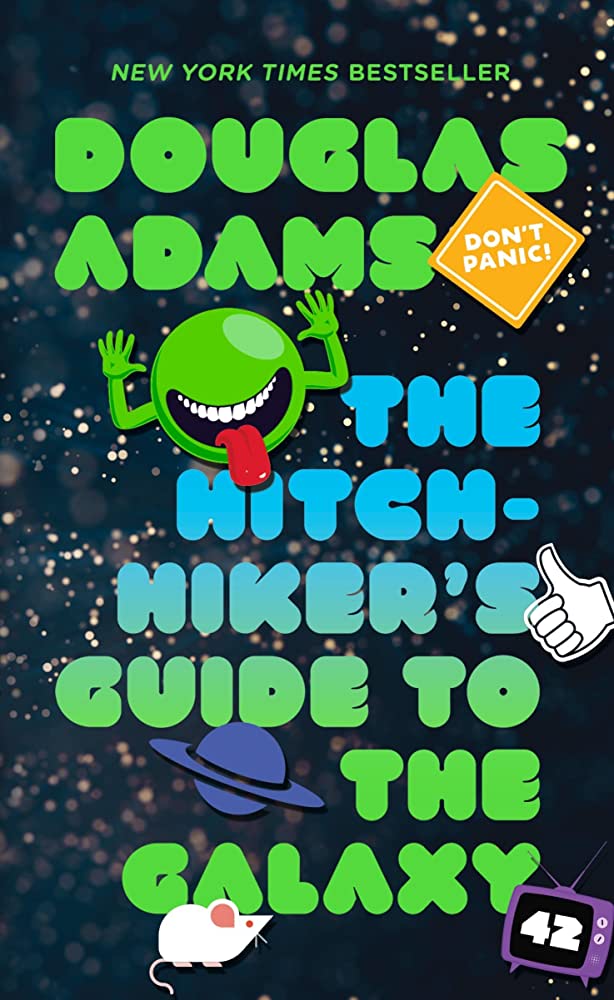
Written by Douglas Adams, The Hitchhiker’s Guide to the Galaxy is one of the most famous science fiction works out there, and one I had heard about for years without ever experiencing myself. This past Christmas, I mentioned I would like to read it, and wound up with the whole 42nd anniversary box set, and the knowledge that this was actually a five book series and not just the one novel like I had been led to believe. But that surprise is no excuse to not enjoy the whole set, so now I have been granted the opportunity to discuss what this series is, and how well it holds up, forty four years after it was first written. So here’s the honest truth about these books, from somebody who went in for the first time this year, knowing nothing other than that the number 42 was important.
The first thing I learned was that this was a comedy series. These books are very much the sci-fi cousins of Alice in Wonderland, featuring a deluge of absurdist humor and dry British wit that is more concerned with wordplay and wacky scenarios than it is with having a coherent plot. How incoherent is the plot? Well, let’s play a game. Here are fourteen potentially true statements about it. Read the list, and the, before continuing, take a guess at which ones you think are real, and which ones I made up:
- The protagonist learns to talak to birds and then wishes he didn’t
- Dolphins successfully run a “save the humans” campaign
- Humanity is proven to have descended from hairstylists
- A game of cricket nearly ends the universe
- Somebody spends half a book transmitting incorrect times to clocks across the galaxy as a practical joke
- Mice pilot razorblade mechas in an attempt to lobotomize a British man
- A bowl of petunias vows revenge against a man; nearly succeeds
- A love interest is introduced and is then retconned out of the timeline as soon s the characters hook up
- Somebody time travels so much that he becomes 47 times older than the universe. This is never relevant
- They can’t pilot the ship because all of its computers have shut down functions in order to better learn how to make tea
- The crew’s token woman does nothing for three books and then prevents a galactic war in the span of two chapters
- Astrology is actually correct, but you have to measure it based on a planet near Pluto, not Earth
- The characters escape to the future by hopping onto a worn couch that spontaneously appears in front of them
- An alien disguises the fact that he has two heads by convincing people the second one is just a parrot.
Okay, have you taken a moment to consider which of those I made up? Good. Now, if you’ve read the books, you know that I actually didn’t make up any of them, and that everything on that list happens at some point. This is a series where things happen, often with little explanation as to how, and the characters kind of just roll with it by not questioning much and proceeding to the next gag. While there are plotlines that should probably be treated with importance in a normal series, such as galactic warfare, the destruction of the planet Earth, and hunting down the man who rules the universe… none of it is. The characters themselves are not particularly impressive either (excepting maybe Marvin). Arthur is almost exclusively a viewpoint character who simply reacts to things, Ford doesn’t care about affecting the plot, Zaphod clearly exists to spite conventional rules of literature, and Trillian is mostly there to add some estrogen to the group. This is not a series you read for its plot. This is not a series you read for its deep characters. This is a series you read for the sole purpose of laughing at the absurdity of it all. While not particularly deep or even well characterized, the aforementioned five man band somehow manage to have a perfect dynamic that allows them to approach any situation in more or less the exact same fashion, dryly react to it in the most understated way possible, and then get moved to the next plot point by their questionably sentient ship. Arthur is barely given time to react to the destruction of his home world before he gets dragged into a wordplay gag about how difficult it is to heat drinks in space.
And frankly, the series is all the better for it. You could not maintain the slapdash pacing of the series and wacky jokes while also trying to emotionally invest in anything that is happening. The weakest book (paradoxically) is very much the fourth one, So Long, and Thanks for all the Fish, because it is the only one that tries to get the reader emotionally invested into anything. Never before have I seen a series that cares so little about any of itself, and yet it absolutely works. Nearly fifty years after the books were written, the jokes still land perfectly, if only because they focus more on wordplay, subversion of conventional genre expectations, and relatable everyday situations pushed to absurdity, rather than relying on any type of humor that could grow dated. I went into these expecting a famous sci-fi story about the meaning of life, based on what little I knew of the 42 gag. Instead, I got a sincerely hilarious series that had me repeatedly laughing out loud as I read along. Hitchhiker’s Guide asks you to ignore the “rules” of literature and simply go along for the ride; while it can’t promise you a deep plot or anything you would normally ask aa book for, it can promise a steady stream of laughs that can only exist because the books care so little for things like “narrative cohesion” and “rational events happening in a rational sequence.”
Absurdism is a difficult thing to write. Not because we can’t come up with weird situations, but because crafting scenarios that so closely resemble the lives of the readers while also defying every known definition of reality is something only a master wordsmith can accomplish. For as weird and unexpected as his work was, I think Adams was exactly that. I’m obviously not saying anything new here; these books are well-known for a reason, and the prestigious names who stopped to write the forwards in the versions I have said it far better than I can, but it is a rare thing when we expect a certain experience, yet come out happy with a completely different one. I thought these would have a series plot, akin to the episodes of Doctor Who I had seen (apparently this series started as a handful of rejected scripts for that show), and instead, I have been reminded of just how many ways there are to communicate an idea, and that telling a story can sometimes get in the way of actually doing what you intended to. No mount of coherent storytelling would have improved the experience I had with these books, as it would have detracted from the constant laughter and the bizarre nature of a galaxy that feels much too much like home. Just enough of a plot thread exists to ensure each scene leads into the next, but the nature of that thread can be so tenuous that the reader can visibly see it falling out of the book’s spine.
Hitchhiker’s Guide might not offer the same joy I found in it to you. It frankly asks a lot by throwing off the shackles of genre convention so eagerly. Plot points will be dropped and half-heartedly picked back up later. Characters are talking pinballs that exist to get bounced into the next scene s soon as they react to the current one. There is no concept of story pacing, nor is gravitas given to pretty much any scene. Plots will be resolved by devices that never come up again and which seemingly spawned out of a pun or bit of misspeak. It is, in a word, weird. Sometimes it feels like all of that is coincidental, and sometimes it feels like a prophetic fusion of classic Looney Tunes style humor with the postmodern internet memes of today. And even if I wound up enjoying that, I cannot pretend it is not the least bit off-putting. I generally like a plot and a loveable cast who have agency in their own stories. But when it becomes apparent that the goal is not to have these things, but just to tell jokes and make observations about life, I can forgive it all. Too often do we try to do a bit of everything without seeing that which forms the goal. I am reminded of an old Magic School Bus episode, where Miss Frizzle reveals a homemade instrument isn’t working because the students stuck too many different parts and ideas onto it, but could be great if they removed a few. In Hitchhiker’s Guide and its sequels, Adams understood this meaning, and stripped his books of everything except their primary purpose, and the bare minimum of literature needed to function. It would have been a worse, more forgettable series had it strived to have everything I normally look for in a story.
With all that said, I do not think I would want to see more books attempted like this. Part of what makes this series special is how truly unique it is. While I drew a comparison to Alice’s Adventures in Wonderland earlier, there really isn’t much else that strikes the tone of these books. And in trying to replicate it, I believe we would dilute the pool of existing literature by simply producing knockoffs that rob the original of what once made it special. I haven’t seen the movie or any other versions of the story, but I somehow imagine a proper adaptation would resemble the Naked Gun films more than anything else, in that the movie would be visibly falling apart as you watched it, and that would be the joke. Part of what makes these so enjoyable is that there really isn’t another place to get this kind of irreverent absurdism without accepting a drop in quality. The characters can be lost in space, in the midst of a war, knowing their lives are about to end, and they will still ignore all of that to have a Seinfeld-eqsue conversation about something very familiar to day-to-day life. And then that will somehow segue into their escaping death by the skin of their teeth because of some loosely connected thought only reachable by the deranged wordplay and conversational patterns of this very odd cast. It’s difficult to replicate. So difficult, in fact, that I would wager that is why these books are still talked about. They come from a special kind of mind that sees everything around it for exactly what it is. Because when we break it all down, real life isn’t that much more reasonable than what goes on in these books. It just has more consistent gravity.
 Nerdcrash!