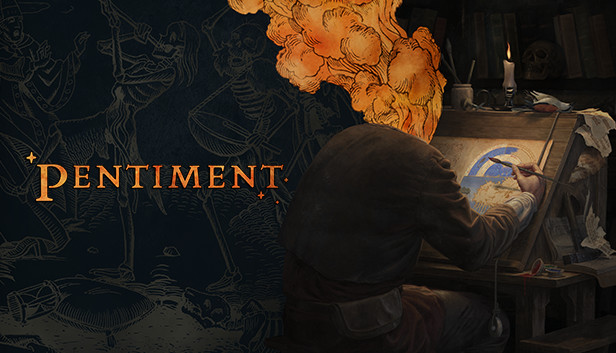
Released in late 2022, Pentiment is a point and click narrative game developed by Obsidian Entertainment and published by Xbox Game Studios. Pentiment is a breath of fresh air in the point and click genre with its rich story and unique art direction. Pentiment’s art style takes inspiration from hand drawn manuscripts and stained glass from the Middle Ages. Through its art style and well researched setting, the game makes the player feel as if they were teleported back in time to the beginning of the Protestant Reformation in Europe. I played through Pentiment once and it took me around ten hours to complete the playthrough. In the future I definitely want to playthrough the game again to experience different outcomes on my choices, for Pentiment is a rare game where choices the player makes actually do affect the story on top of dialogue options. Pentiment only contains one game mode, its story. This review will contain spoilers to the story, so be warned.
Game reviews done in my style are organized into five categories, with each being graded on a scale from one to five. At the end of the review, all the categories will be summed up to determine the game’s letter grade. The five review categories include: gameplay, story and characters, visuals, soundtrack and sound design and quality of life. Gameplay is game and level design, the quality of the combat, traversal mechanics and skill tress. Story and characters judge the narrative and character development. Visuals discusses the quality of the graphics and art direction. Soundtrack and sound design looks at the original score, sounds and ambient music that fills the world with sound. Finally, quality of life grades the game on user interface and game stability.
Gameplay
As a point and click adventure RPG, Pentiment does not offer much in terms of diverse gameplay. In fact, I played the majority of the game with one hand and my feet up. All that was required was a mouse to play Pentiment. It was definitely a change of pace compared to most games I play where my whole body is invested into the experience. But if you are looking for a game with evolving gameplay or combat, then Pentiment isn’t for you.
To make up for the lack of combat or map traversal, Pentiment has a persuasion mechanic where dialogue choices and the actions you make effect the decisions of the characters you interact with. The result of these persuasion challenges impacts the difficulty of story tree it’s involved with. What that means is that, even if you fail a persuasion challenge, which I often did, the option still lays open for you, but becomes riskier or more difficult. For example, one challenge I failed involves asking the Prior permission to dig up a grave. I failed this challenge due to me speaking out against the Prior so he didn’t give me permission. So, I had the option to go behind his back and request assistance from a friend in town to complete the task instead. I ran the risk of getting caught and that weighed on my mind before going through with it. And that’s Pentiment’s strength, creating an atmosphere where every decision has weight on it.
On top of the persuasion mechanics, Pentiment allows the player to grant their character some background, which opens up different dialogue options. Some of these include personality types, education and county of origin. Some of the dialogue trees are flavor related, describing the area and the time period that serves as the setting of the game. As an amateur historian, I can respect the amount of detail that went into recreating the time period and helping with the immersion. These dialogue trees can also have an impact on the story, as you can use these options to unlock knowledge to help you solve the mystery or develop your relationship with the characters. However, other than enhancing the dialogue options there isn’t much to Pentiment’s gameplay.
Pentiment’s gameplay score is a 3/5.
Story
Pentiment’s story follows Andreas Maler in the 16th Century as he practices his art at the Bavarian abbey of Kiersau and lived in the nearby town of Tassing. One day a local baron is murdered on the abbey’s grounds and Andreas’s mentor and friend, the aged Piero is blamed for the murder. The first phase of the story follows the investigation that Andreas undertakes to clear Piero’s name. The details of the investigation depends on the player’s choices. After the course of the investigation which allowed the player three in game days divided into different time sections, which are used up with activities, the player informs the local magistrate who they believe the culprit actually is. During my Act I investigation, I deemed Prior Ferenc as the culprit due to discovering his connections to occult relics, aka pagan sacrifice and worship.
Act II follows Andreas again, but years later after becoming a renown master artist and accompanied by his apprentice Caspar. Andreas returns to the abby to pay his respects to Piero’s grave who passed away from old age. Unfortunately, when Andreas arrived tensions were high between the peasants of Tassings and the abbot, who was their liege lord and demanded high taxes of them. During his visit, the leader of the peasants and Andreas’s friend Otto is found murdered. To prevent a fullscale riot, Andreas promises to investigate once again. For my Act II investigation I found that Brother Guy was the culprit for I found evidence that he was stealing from the abbey and Otto learnt of it, so Guy killed him to prevent anyone else from knowing. However, after the peasants lynch Guy and also the asshole miller, the marched on the abbey where they burnt the structure down and a fight ensued against men of a local lord. Andreas succumbed to the flames in attempt to save the books of the abbey.
Act III this time follows Magdalene Druckeryn, the daughter of the local printer, who takes over the creation of a mural after her father is attacked by a mysterious assailant. Instead of a murder investigation, the story transitions into learning more about the origins of Tassings and Kiersau. Along the way learning more about the pagan and roman roots of the city, all the while under the eye of someone following Magdalene. This person turned out to be Andreas who survived the fire and was saved by Caspar, who didn’t survive. The pair together tracked down the puppet master of all the killing and violence that haunted the area since the start of the game.
Pentiment’s story is a well-crafted mystery that has multiple outcomes based on the choices that the player makes throughout the course of the game. This story is amplified by the well written characters the in-depth research into the historical setting. Andreas in particular is a strong character who is overtaken by success and falls into depression as he seeks to redeem himself for his actions. Though the identity of the puppetmaster is a little out of the blue and unsuspected, the result was a satisfying ending.
Pentiment’s story score is a 5/5.
Visuals
As stated earlier, the highlight of Pentiment is its unique art style. Pentiment’s use of hand drawn manuscript style helped draw the player into the immersive historical setting that Obsidian built. The manuscript style also animated better than I was expecting. Although the animation appeared slow at times, the movements were accurate and believable. The lighting and color of the animation was accurate to the time of day in the game. In addition, the amount of detail in how the dialogue is presented to the player is as exquisite as the graphics. The dialogue’s script was based on the social standing of the character speaking. For example, the peasants spoke differently from the priests, who spoke differently from shopkeepers. All of the details placed in the art style, from the character design to the backgrounds all showcased the change of time in the game as well as make the player feel the impact of their choices. Like walking through the abbey in the third act after it burned down. Pentiment’s art direction is definitely award worthy and the best I have seen in years.
Pentiment’s score for visuals is a 5/5.
Sound Design
Pentiment’s sound design in comparison to its visuals, is rather ordinary. The sound design’s strength is in its ambient sounds. Obsidian did well in crafting sound effects that make the player really feel as if they are in a 16th Century town or wandering through a forest. Birds chirping, wind blowing, and the sound of distant chatter are just some of the sounds that were present through the game’s environments. Most of the time, the ambient sounds are the only sound present in the game, as Obsidian opted for limited use of music. When music is used, however, it is done well. The soundtrack mostly comes into play during plot events or mood swings in the games story. Creepy crawling music upon discovering a clue or a bard singing his tune are some of the music in Pentiment. Obsidian’s choice for musical background is different than many games I have played, for normally games I play have an orchestrated soundtrack, like Skyrim or Breath of the Wild.
Pentiment’s score for sound design is a 3.5/5.
Quality of Life
Because Pentiment was a small game compared to other games that Obsidian Entertainment have developed, the quality of life present in Pentiment is high. I didn’t experience any crashes or slowdowns during my playthrough. Pentiment is a well-polished game that knows its identity, meaning that Obsidian didn’t inflate Pentiment with extra features or game modes, which would have otherwise harmed the overall presentation of the game. With a price tag of around $20 for a game with around ten hours per playthrough is an absolutely great deal, especially for a game as beautiful as Pentiment.
Pentiment’s score for quality of life is a 5/5.
Verdict
Obsidian Entertainment crafted a game with a strong story and characters, supported by beautiful graphics and strong ambient sounds. Instead of making the lack of combat a weakness in its gameplay, Obsidian turned it into a strength by replacing it with mental puzzles and complex dialogue that wasn’t too confusing for the player. Pentiment is a game where the player’s actions reflect the outcome of the story and offers different endings that encourages replayability for its player base. This is something I am going to do again in the future once the memory of the game fades after some time, so that I can experience the story again, but with a different approach. The game’s quality is boosted by its consumer-friendly price tag.
Pentiment’s final score is a 21.5/25 or a solid B.
 Nerdcrash!
One response to “Pentiment Review”
Solid review, felt informed after reading.
LikeLike