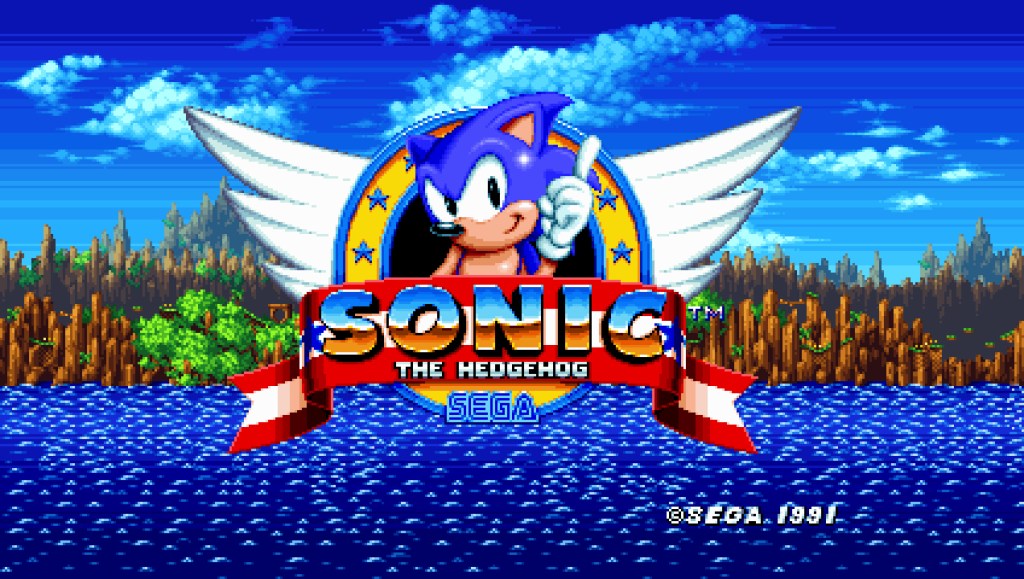
The Series Retrospective is a running series of articles I plan to write for this blog. Over time, we’ll be iterating on it by going over multiple series, examining the major entries and the development of a franchise. But to start us off, we’re going to take a deep dive into the history of the Blue Blur himself.
The early 90s were a different time for the gaming industry. Titans Microsoft and Sony had yet to enter the ring, arcades were still relevant, Tomb Raider and DOOM had yet to legitimize PC gaming, and functional 3D was still out of reach for game developers. After the Atari’s fall from grace, there were only two major console producers, Nintendo and Sega. While other consoles existed aside from what these two produced, nothing else had any real market share. The Console War was going into full swing, and it looked like Nintendo was the unavoidable victor. Sega boasted a more powerful console, sure, but Nintendo had secured greater third party support by being first on the scene, and had already begun to amass its collection of gaming icons with Mario, Donkey Kong, Link, Samus, and co. Coupled with third party characters like Megaman, Erdrick, and the Belmonts, the Big N held a monopoly on recognizability. When it came to selling titles in this time, the console specs were still too much for most people to wrap their heads around, and the games were the absolute defining features of these consoles. Having a mascot meant sales, because it provided both a trustworthy franchise for players to keep returning to, and a face to the system that told parents what their kids would enjoy playing. Faced with the challenge of matching Mario, Sega’s most viable mascot character was… Alex Kidd, famed for defeating his enemies by literally playing Rock-Paper-Scissors. It’s no wonder that Sega was losing the battle. But the year was 1991, the Genesis was a powerful console, and if they wanted to avoid failure, they would need something greater than Alex Kidd. Enter Sonic the Hedgehog.
Sonic wasn’t an instant success in his home country. In Japan, Sonic is just another platforming series, mostly favored due to its history. But in the West? He’s almost as synonymous with video games as Mario is. So how did that happen? The hedgehog is a character who could only have come out of the exact time period and circumstances that he did, as those same circumstances are what would ultimately shape the character. Mario, for comparison’s sake, is the classical everyman. The goal of his character is to appeal to everyone, and he absolutely succeeded at that in the same way other everyman characters like Mickey Mouse did before him. But if you’ll allow me to stick with this analogy, Sonic isn’t Mickey Mouse; Sonic is Donald Duck. Mario’s strength is that you can stick him into any story and he can play along perfectly. Sonic’s strength is the exact opposite: you can stick him into any story, and now the story has to deal with the fact that Sonic is in it. Keeping with the archetype of the “90s Cool Kid,” Sonic is defined by one thing in particular: his attitude. He’s not the instantly friendly Mario, but he is a character who immediately appeals to the eye, with his striking design of soft blue, Looney Tunes-esque animal body, and spiky hair. And most importantly, you can see and understand his personality the second you look at any shot of him.
Sonic both epitomizes the 90s, and defies the wide-range appeal of his competition. As a character built for speed (as any of his games’ advertising will tell you), he is custom made to show off the stronger processing power of his debut console, and perfectly suited to appeal to the same populations who are developing the now identifiable defiant mindsets of the 90s, as well as capturing the growing extreme sports movement of the time with his high speed movement and half-pipe inspired level geometries, debuting a mere three years before the first X Games would be held. Similarly, Sonic’s initial conflict is to protect animals from the local industrialist, mirroring the growing environmental concerns of the time. There are few better cases of perfectly encapsulating an era within a single character, and for a moment, Sonic was the time of his debut, too cool for school and all. While their competition focused on nearly silent characters who could serve as self inserts as mascots, Sega would follow Sonic’s personality-driven formula to create well-defined characters to serve as their mascots, eventually leading to characters like Sparkster, Ulala, and the Streets of Rage crew. Sega had their perfect mascot, and now all they had to do was give him a game worth playing, a real killer app to rival the likes of Super Mario World and Final Fantasy. And did they deliver? Well, no.
Sonic the Hedgehog, as a first game, is more than serviceable, but it is very much a game that is at war with itself, uncertain of what it wants to be. For all the hype about Sonic’s speed, the multiple routes through levels he will be able to take, and the fast-paced action contained within each zone, Sega didn’t exactly do as they said they would. Green Hill Zone is an immaculate level that perfectly does everything they advertised, giving Sonic the perfect space to run around in, featuring the famous loop-de-loop runs that would prototype the more spectacle based segments of later titles, and introduced us all to the first of the many, many great songs that would grace the franchise’s soundtrack, but it was ultimately the first zone. All three levels of it were a great first zone, and it would conclude in an easy, but menacing (for a child) introduction to Dr. Eggman, but the game also needed to follow up Green Hill with something equally impressive. Instead, we got Marble Zone.
The immediate follow-up to the glory of Green Hill Zone is a slow-paced, puzzle platforming area that involves waiting around for blocks to float through lava, slowing your momentum, and hoping the falling traps will raise themselves back up just a little faster. And to be quite honest, it is, in some ways, a better level than Green Hill Zone. Green Hill is the perfect idea of what Sonic was meant to be, but the game itself can hardly support it. Sonic Team was new to their jobs, and didn’t quite have a handle on how to design challenging levels around Sonic’s speed. So instead of more of Green Hill’s free flowing antics, the bulk of the game is littered with traps and enemies that will kill you for going too fast, and there are points where Sonic can move so fast that the scrolling screen fails to keep up with him. These traps become especially problematic when you consider the Rings Health System. I’ll talk more about why Rings has always been a questionable system in a later article, but when you lose your rings, you also lose all forward momentum, and become a 1-hit wonder who needs to go very slowly in order to avoid instant death at the hands of something you don’t have time to react to, until you find more rings. Marble Zone’s slower pace lends itself to a different type of game, one where Sonic 1’s physics and movement feel much more controlled, and where the player is consistently the one in control of the situation, only taking damage when it is their own fault. Based on how the rest of the game is built, the development team likely believed that this was how the game should play, as barring a few areas of Starlight Zone, the game never returns to the free running style of Green Hill. Many will tell you that this is because you are expected to master the game through replays and memorization, but the fact of the matter is that Sonic 1’s level design is built to slow you down. The game fights you if you want to go fast, and instead lends itself to a slower, exploration focused style, hence why Marble Zone, despite not being what Sonic the Hedgehog advertises itself as, is so well made when taken in a vacuum. Beyond these two levels, the game is a mixed bag that generally leans towards good. Spring Yard Zone has a good bit of spectacle in the way it pinballs Sonic around, but this largely removes control from the player and puts them at risk of getting launched directly into spike
traps. Labyrinth Zone features more of the slower puzzle platforming of Marble Zone, introduces the player to the water mechanics that will becomes standard across the rest of the series, and ends in an interesting boss. Whereas all of the game’s other bosses feature Eggman piloting his eggmobile with a weapon attached, this battle consists of chasing him through a series of traps. On paper, this sounds like the perfect way to blend Sonic’s speed into a boss battle, attempting to catch up to him without stepping into the traps. In practice, the battle is miserable, as the entire chase is vertical, forcing the entire thing to consist of slowly climbing up trap covered walls instead of being allowed to run. Starlight Zone never quite reaches the highs of Green Hill, but is the most reminiscent of it, once again focusing on Sonic’s ability to speed through an area. Scrap Brain Zone is a level that looks like it was initially set up for speeding through, but the aggressive enemy and trap placement also results in most players needing to take it slowly as they navigate the death trap. Final Zone barely warrants mentioning, as it solely consists of a boss fight, albeit a good one that only allows 1-2 hits against Eggman per attack cycle.
For the sake of completion, I should also mention the Chaos Emeralds, the all-important macguffins of the Sonic series.
There’s only six of them instead of the usual seven; put that down to early installment weirdness. You procure these by reaching the end of a level with 50 or more rings, triggering a bonus stage where you have a chance to win one. This makes the Ring Health System almost make sense, as even if the number of rings has no effect on your survivability so long as the number is greater than zero, you need to save enough to actually attempt the bonus stage at the end. Granted, this also makes dropping all of your rings if you got hit by something you were moving too fast to react to even more painful, as you can have a nearly perfect run and lose your chance at the very last second. Collecting them all in a single playthrough results in a slightly different ending, which isn’t much of a reward relative to what they do in the later Genesis titles,
but it does encourage learning good play and mastering the game, which was integral for a Genesis title, given that, like most games on the system, Sonic the Hedgehog had no save files and could be beaten in under two hours by all but the most incompetent players. Once again, we see bits of Sonic’s inspiration here: a reward for mastering the game, a reason to interact with the game’s most unique system, and the personality filled Eggman taunting you at the end if you failed to grab all six. The bonus stages themselves, however, consist purely slow, puzzle-like gameplay, asking you to steer Sonic through a rotating maze as if he was a pinball, rather than allowing him to run normally. This minigame would not return in future installments, because the developers realized it was too antithetical to what Sonic was. It did not use his speed or grant him any control over himself, making him into an object instead of the cool dude staring back at you from the title screen.
Sonic 1 is an alright start to a series, but is inherently uneven as a result of this split in focus. The character and advertising want you to blitz through it, but the actual game’s levels and physics tell you to slow it down. This internal battle prevents the game from delivering fully on either end of the spectrum, and it’s clear that the developers knew it, because they made two sequels to this game. Not two sequels of Sonic, but two sequels to the first game. Each of these would focus on one half of the game’s strengths, one on the speed and mastery, and one on the slower exploration and platforming. Sonic wasn’t an instant success, but he did get enough eyes on the Genesis for its other games to shine. Streets of Rage, Ecco the Dolphin, Comix Zone, Phantasy Star, Rocket Knight, and many others would keep the system alive and thriving after Sonic gave it its much needed mascot. But it wouldn’t be until the next pair of games that Sonic himself would begin to find his footing…
 Nerdcrash!